Wells Fargo Branch Embraces Barrier-Free Access Honoring Disability Advocate Milbern
A New Era of Accessibility at Wells Fargo
Wells Fargo, one of the major U.S. banks, has taken a significant step toward inclusivity with its newly renovated Georgetown branch in Washington, D.C. Known for its red brick exterior and arched windows, the branch exudes classic charm. After a major renovation, it reopened on November 25 of last year, marking a shift in how banks approach accessibility for people with disabilities.
This renovation stands out due to its “significantly lowered threshold,” which is not a metaphorical reference to relaxed loan requirements. Instead, the branch has been transformed to near-barrier-free standards for individuals with physical disabilities. Key changes include lowering counter thresholds to allow wheelchair users to receive financial consultations easily. Braille signage was also installed for the visually impaired, and American Sign Language (ASL) equipment—a laptop-like device—was added to facilitate communication between hearing-impaired customers and bank staff.
A Broader Initiative for Inclusivity
Wells Fargo plans to follow the Georgetown branch’s example by remodeling all 40 of its branches in Washington, D.C. This initiative seems counterintuitive given the rapid decline in offline branches as mobile banking becomes more dominant. However, the decision reflects a commitment to creating an accessible environment for all customers.
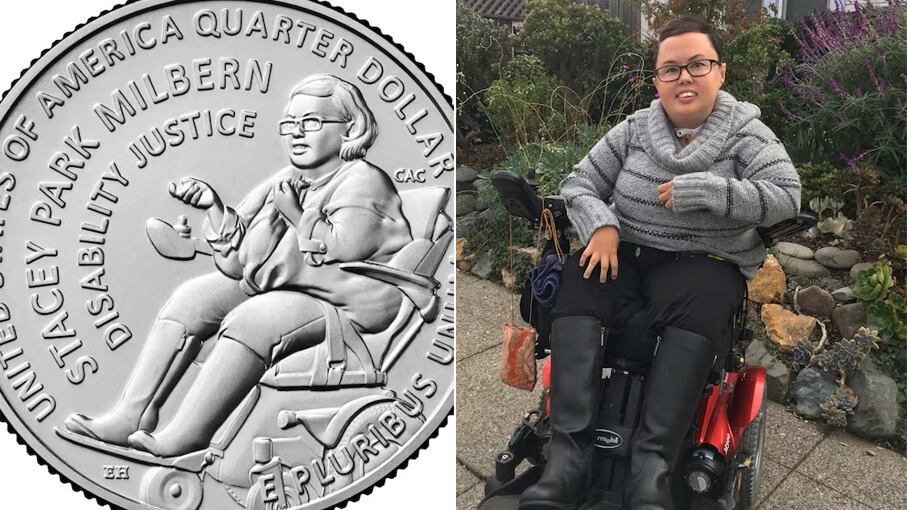
The inspiration behind this move came from Stacey Park Milbern (1987–2020), a Korean-American disability rights activist and the first Korean to be featured on U.S. currency (the 25-cent quarter). The reopening event was effectively a tribute to her. Customers were given the chance to exchange their 25-cent coins for new ones bearing Milbern’s likeness.
Honoring a Trailblazer
These newly minted coins, issued since August, feature George Washington on the obverse and Milbern passionately delivering a speech in her wheelchair on the reverse. Wells Fargo secured 12 million units (face value of 3 million U.S. dollars) to distribute to customers. The coin is the 19th in the U.S. Mint’s “American Women Quarters Program,” which honors 20 women who contributed to American society in the 20th and 21st centuries.
Milbern was born in 1987 at the 121st Hospital in Yongsan, Seoul, to Joel Milbern, a U.S. soldier stationed in South Korea, and his Korean wife, Jin Milbern. She was born with a degenerative muscle disease. Growing up in the U.S., she began to fully recognize her physical differences from others after a fall in fourth grade.
During her teenage years, her heartfelt blog posts about the inconveniences and injustices faced by people with disabilities and how society should address them gained significant attention, propelling her into the spotlight as a human rights advocate. At 20, in 2007, she played a leading role in persuading the North Carolina state government to include disability history in public high school curricula, earning her national recognition.
A Legacy of Advocacy
After graduating from Methodist University, she moved to California at 23 and dedicated herself to advocating for marginalized groups, including people of color, low-income individuals, and the homeless. The Barack Obama administration appointed her to the Presidential Committee for People with Intellectual Disabilities. It was during this time that she began her association with Wells Fargo. From 2014 to 2020, she worked as a member of the Accommodation Management Team, a group responsible for creating a non-discriminatory workplace for people with disabilities.
Even amid the COVID-19 pandemic, she led emergency response teams to deliver masks, medications, and hygiene supplies to the elderly, disabled, and homeless, which ultimately worsened her health. She passed away on May 19, 2020, her 33rd birthday. Five years later, she was honored as part of the “American Women Quarters Program” alongside notable figures like poet Maya Angelou, astronaut Sally Ride, and First Lady Eleanor Roosevelt.
Commemorating Her Impact
In response, Wells Fargo, her former employer, launched commemorative initiatives. They renamed a scholarship for students with disabilities the “Wells Fargo Stacey Milbern Scholarship” and began remodeling branches to be accessible to everyone, regardless of disability.
The Georgetown branch, the first to undergo this transformation, was reopened with Milbern’s father, Joel Milbern, as the guest of honor. Her mother, Jin Milbern, recalled her daughter’s time at the bank: “She said it wasn’t easy. She had to listen to the struggles of employees with physical limitations and consult with lawyers. So she joked, ‘Maybe I should have gone to law school instead of business school.’” She added, “Her Wells Fargo colleagues still remember her as someone with exceptional passion and a strong sense of responsibility.”
A Vision Realized
Sophia Dadas, Wells Fargo’s Head of Branch Strategy and Growth Markets, stated, “Stacey’s remarkable resilience, as both a Korean-American and a wheelchair user, has inspired many. She was the first person with a disability and the first Korean-American to be featured on U.S. currency.” Photos of Milbern, along with her biography and quotes, are displayed at bank counters for customers to see. One of her quotes reads, “People with disabilities are beautiful not ‘despite’ their disabilities but in their authentic selves.”
Meanwhile, Milbern was recently recognized by the Overseas Koreans Agency for her contributions to protecting the rights and establishing the identity of second-generation Koreans abroad. Her legacy continues to inspire change, ensuring that the world she envisioned slowly becomes a reality.
Post a Comment