Bulgaria Embraces the Euro Amid Divided Public Response
Bulgaria Joins the Eurozone: A New Chapter with Mixed Reactions
Bulgaria officially adopted the euro on Thursday, becoming the 21st country to join the European currency. This significant milestone was celebrated by many but also raised concerns among a portion of the population. Nearly two decades after joining the European Union, the Balkan nation took this step in hopes of strengthening its economic ties with the West and reinforcing its position within the EU.
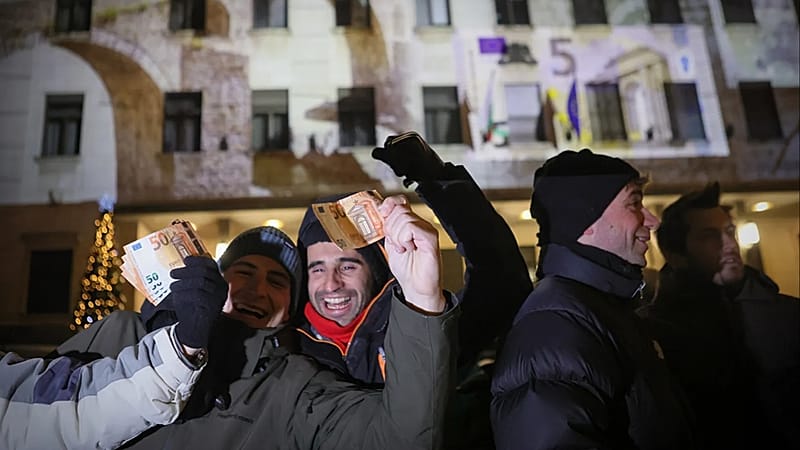
At midnight, Bulgaria transitioned from the lev, a currency that has been part of the country’s identity for centuries, to the euro. The central bank building in Sofia was illuminated with projections of Bulgarian euro coins, marking the symbolic shift. Christine Lagarde, president of the European Central Bank, welcomed Bulgaria into the euro family, describing the euro as a powerful symbol of shared values and collective strength.
For many Bulgarians, the switch was met with excitement. Dimitar, a 43-year-old man, expressed his joy after withdrawing €100 from an ATM shortly after midnight. “Great! It works!” he exclaimed. However, not everyone shares this enthusiasm. Successive governments have long advocated for the adoption of the euro, hoping it would boost the economy of the EU's poorest member state and help protect against Russian influence. Despite these expectations, public opinion remains divided.
Public Concerns and Political Divisions
The decision to adopt the euro has sparked debates about its potential impact on prices and political stability. President Rumen Radev praised the move as the "final step" in Bulgaria's EU integration, but he also expressed regret that the public had not been consulted through a referendum. This omission highlighted the deep divide between the political class and the people, a sentiment confirmed by mass demonstrations across the country.
Anti-corruption protests led to the removal of a conservative-led government in mid-December, leaving the country in a state of uncertainty. With inflation rising and the nation preparing for its eighth election in five years, many Bulgarians are anxious about the future.
At one of Sofia's largest markets, vendors displayed prices in both levs and euros. Retiree Vlad offered a hopeful perspective: “The whole of Europe has managed with the euro, we'll manage too.” For him, the euro represents a sense of belonging.
Economic Implications and Public Sentiment
European Commission President Ursula von der Leyen called Bulgaria's move into the eurozone an important milestone, highlighting benefits such as easier travel, improved market transparency, and increased trade opportunities. Central Bank Governor Dimitar Radev emphasized that the euro is more than just a currency—it is a symbol of belonging.
However, according to the latest Eurobarometer survey, nearly half of Bulgarians oppose the switch. Outgoing Prime Minister Rosen Zhelyazkov sought to reassure the public, stating that he was counting on their tolerance and understanding. He also claimed that inflation in the Black Sea nation was not linked to the euro’s adoption.
Despite these assurances, concerns about inflation remain valid. Food prices rose by 5% year-on-year in November, more than double the eurozone average. Pastry shop owner Turgut Ismail noted that prices have already begun to surge, saying, “Unfortunately, prices no longer correspond to those in levs.”
Protests and Economic Fears
A euro protest campaign in 2025, led mainly by far-right and nationalist parties, reflected widespread skepticism about the single currency. Many Bulgarians fear price hikes and have expressed frustration over the difficulty in obtaining euros. Shopkeepers reported delays in receiving euro starter packages they had ordered.
“It's not the right time,” complained Stephane, a 64-year-old economist. He pointed to the high debt levels of other Eurozone countries, warning that Bulgaria might eventually bear the burden. Petar Ganev, a Senior Research Fellow at the Institute for Market Economics, noted that the long-term effects of the euro could boost confidence in the currency and attract foreign investment.
The adoption of the euro could also impact Bulgaria’s credit rating. Credit agencies may deduct from the country’s rating due to the currency board, according to Ganev.
Cultural Symbols on the New Euros
The new Bulgarian euro coins feature cultural motifs that reflect the country’s rich history. The Madara Rider, a rock relief from the eighth century, appears on the one, two, five, 10, 20, and 50-cent coins. This artwork, depicting a knight triumphing over a lion, is carved into a cliff near the village of Madara and is a UNESCO World Heritage Site.
The €1 coin features Ivan of Rila, Bulgaria’s patron saint, while the €2 coin showcases Paisiy Hilendarski, an 18th-century monk who played a key role in Bulgaria’s national revival. The edge of the €2 coin bears the inscription: “God protect Bulgaria.”
Since the euro was first introduced in 12 countries on 1 January 2002, Croatia became the latest addition in 2023. Bulgaria’s accession will bring the number of Europeans using the euro to over 350 million.
Post a Comment