Taiwan Reduces Debt Amid Semiconductor Boom
The Rise of Hsinchu: A New Affluent Neighborhood in Taiwan
On the 5th, at Hsinchu Station on Taiwan’s high-speed rail. Exiting the station, located northeast of Hsinchu—a city symbolizing Taiwan’s semiconductor industry—construction sites for high-rise buildings and apartments were underway everywhere. The Zhubei area north of Hsinchu, especially near the high-speed rail station, is emerging as a new affluent neighborhood representing the city. Luxury apartment complexes are springing up like bamboo shoots after rain, and high-income engineers from the Hsinchu Science Park are flocking here due to the 30-40 minute high-speed rail ride to the capital, Taipei.
Liu Jianhong, who runs Taiching Real Estate, said, “The area near the high-speed rail station was nothing but empty fields just 10 years ago, but now it’s the most expensive land in Hsinchu. Over the past three years, housing prices have nearly doubled, with the average market price reaching approximately 38 million Korean won per pyeong, and the highest-priced apartments hitting around 4.5 billion Korean won, nearing the levels of Taipei’s outskirts.”
The Hsinchu Science Park and Economic Prosperity
The Hsinchu Science Park is indispensable when discussing Taiwan’s semiconductor industry, established in the early 1980s under the government’s vision of a “Taiwanese Silicon Valley.” Hsinchu, a symbol of Taiwan’s economic prosperity, is recognized as the wealthiest area outside the capital region. Particularly, households here, where high-income engineers from semiconductor and electronics companies like TSMC reside, have an average disposable income of 1.5 million Taiwanese dollars (approximately 70 million Korean won), surpassing even Taipei’s 1.48 million Taiwanese dollars to rank first among Taiwanese cities.
Liu added, “Taiwan’s high-income class tends to focus more on preserving assets, such as saving or buying homes, rather than spending on luxury items like cars or designer goods to show off wealth.”
Fiscal Discipline and Debt Management
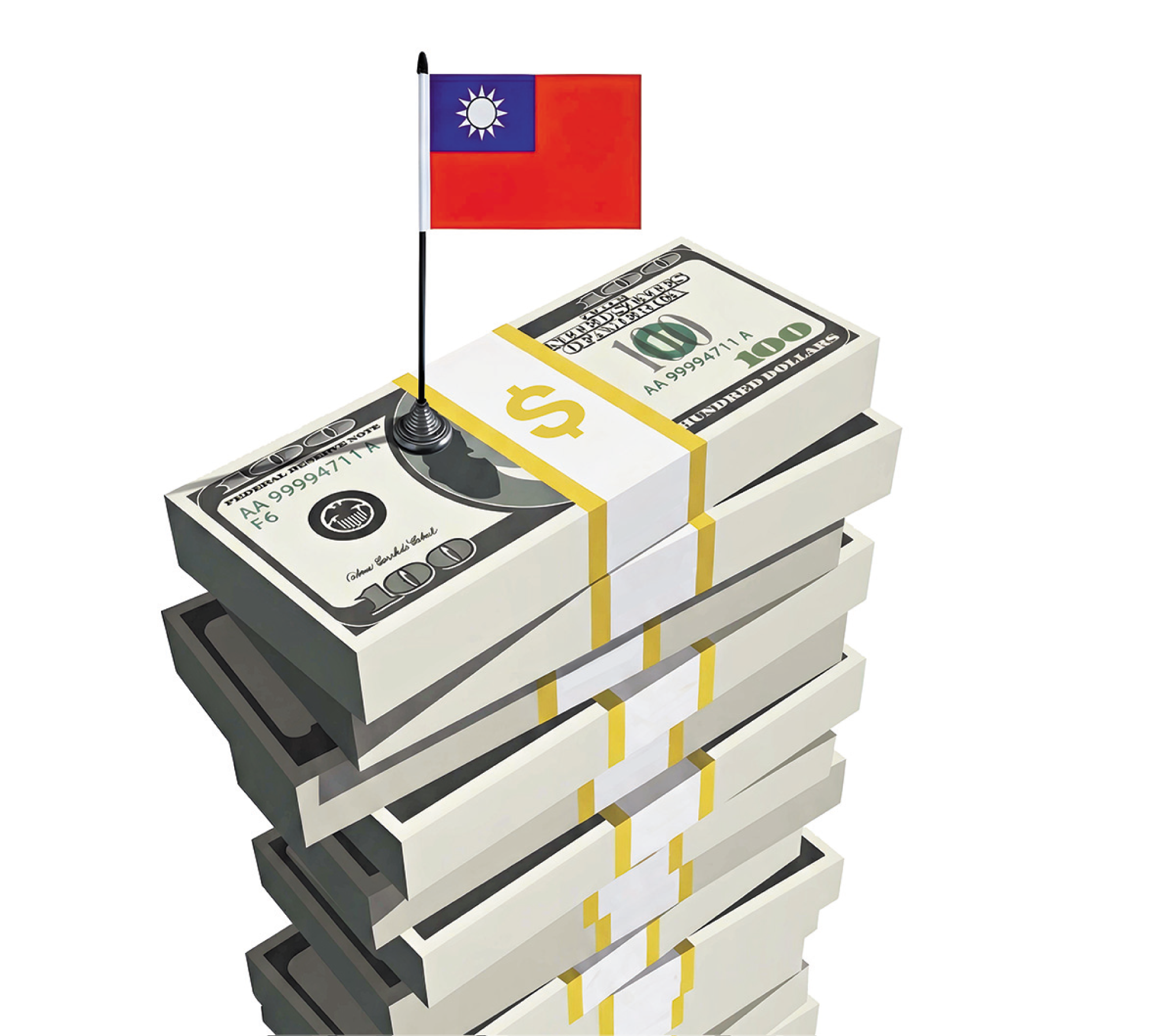
Just as individuals are frugal, the Taiwanese government also adheres to a “tight household budget” policy. Taiwan’s national debt-to-GDP ratio is projected to drop from 36.9% in 2010 to 23.4% this year. This contrasts sharply with South Korea, where the ratio surged from 28.3% to 53.4% over the same period. WEEKLY BIZ examined Taiwan’s strategy of preparing for the future during the semiconductor boom.
All-in on Reducing Debt Despite Massive Tax Revenue
The Taiwanese government announced on the 28th of last month that its real economic growth rate this year is expected to reach 7.37%. While major advanced economies, including South Korea, are projected to grow by around 1% due to global recessions triggered by the Trump-era tariff wars, Taiwan is on a “solo sprint.” Behind this rapid growth is the global “artificial intelligence (AI) boom,” which has caused explosive growth in Taiwan’s electronics exports.
According to October data, Taiwan’s total exports hit a record $61.8 billion (approximately 90.7 trillion Korean won), up 49.7% year-on-year, surpassing $60 billion for the first time. Information and communication technology product exports surged 138.2%, and semiconductor and electronic component exports rose 29.2%, driving overall growth. With a projected 36.8% year-on-year increase in total goods exports for the fourth quarter, AI-related manufacturing is hitting an unprecedented “export jackpot.”
Improved export performance by domestic companies directly expands the government’s tax revenue. Increased revenue often tempts governments to expand welfare spending. However, Taiwan’s government and legislature remain committed to a “tight budget,” cautiously avoiding expansionary fiscal policies. In fact, this year’s government expenditure is approximately 2.92 trillion Taiwanese dollars (about 138 trillion Korean won), a mere 2.5% increase from last year’s 2.85 trillion. This is lower than South Korea’s 3.2% expenditure growth under the Yoon Suk-yeol administration, which emphasized “tightening belts.” Despite the record-high boom, Taiwan’s government and legislature have effectively tightened the national budget. Meanwhile, tax revenue reached 3.16 trillion Taiwanese dollars, recording a historic surplus. When the government began distributing 10,000 Taiwanese dollars (approximately 470,000 Korean won) to all citizens last month—a policy similar to South Korea’s “consumption recovery coupons”—some misunderstood it as expansionary fiscal policy. However, the supplementary budget for this was funded by surplus tax revenue, resulting in virtually no fiscal impact.
Thanks to this strict fiscal discipline, Taiwan rarely issues government bonds to cover uncontrollable spending. Its debt-to-GDP ratio has been declining annually since peaking at 39.2% in 2012. Most bond issuances are limited to the minimum required to repay existing debt. This year, amid the peak of the semiconductor cycle, Taiwan repaid a record 141.5 billion Taiwanese dollars, creating a “net debt reduction” structure where repayments exceeded new borrowings, reducing the absolute debt size. This contrasts with South Korea, which maintained a debt ratio below 40% until 2019 but has seen it rise steadily since. Taiwan is virtually the only country globally to have dramatically reduced its debt ratio in such a short period.
“Don’t Pass Debt to Future Generations” for 30 Years
Taiwan has established strong brakes in its “Public Debt Act” to prevent national debt from skyrocketing. A ceiling of 40.6% of GDP is set for national debt, and at least 5% of annual tax revenue must be allocated to repaying government bonds. While setting debt ceilings is common, legally mandating a portion of tax revenue for bond repayment is rare. The 1996 legislation stated, “To practice the spirit of principal repayment, reduce debt accumulation, and avoid passing debt to future generations.”
Why is Taiwan so meticulous about debt management? Experts cite Taiwan’s unstable external situation as a key reason. Wang Shou-feng, a professor of business administration at Ajou University and a Taiwan market expert, said, “Taiwan cannot join the IMF due to opposition from mainland China and is not fully recognized as an independent nation internationally. If a financial crisis occurs, it could face isolation, forcing conservative fiscal management.” He added, “Due to security and diplomatic issues with mainland China, the negative aspects of fiscal and debt expansion are viewed more seriously than the positive effects, and populist fiscal policies are seen as risky in politics.”
Taiwan’s pragmatic culture also plays a role. Chen Linlu, a professor of business administration at National Taiwan University, explained, “Both major parties (Democratic Progressive Party and Kuomintang) generally dislike increasing debt and view lowering government debt ratios as a measure of administrative efficiency and fiscal control. Above all, Taiwan’s export-driven economy makes domestic demand-stimulating policies through debt less effective.”
Companies Invest Heavily to Maintain ‘Super Gap’
It’s not just the government preparing for the future during the unprecedented boom. Taiwanese semiconductor and electronics companies are also investing generously in facility expansions. According to the International Semiconductor Equipment and Materials Association (SEMI), Taiwanese companies’ semiconductor equipment investments from the first to third quarters of this year reached approximately $24 billion, a 120% increase from the same period last year ($10.9 billion). South Korea, which entered the semiconductor upswing alongside Taiwan due to the high-bandwidth memory (HBM) boom, saw its semiconductor equipment investments rise to $18.7 billion, a 32% increase from $14.2 billion in the same period last year.
TSMC recorded a historic capital expenditure (Capex) of $40 billion to $42 billion (approximately 59 trillion to 62 trillion Korean won) this year. TSMC’s principle is to maintain technological superiority through consistent Capex regardless of boom or bust. This year’s investment exceeds last year’s $28 billion to $32 billion by about $10 billion. On the 25th of last month, local media reported plans to expand its cutting-edge 2-nanometer factories from seven to ten, with mass production starting in the second half of this year. Huang Len-jye, TSMC’s chief financial officer, stated that approximately 70% of this year’s Capex will go to advanced process technologies, 10-20% to specialty process technologies, and 10% to advanced back-end processes and other projects. This clarifies TSMC’s intent to reinvest semiconductor boom profits into maintaining technological superiority.
Implications for South Korea
However, experts note that Taiwan’s model isn’t easily applicable to South Korea. Taiwan’s extreme debt reduction is a unique result of its political, economic, and cultural specifics. As a nation not fully recognized as sovereign internationally, fiscal instability directly impacts its survival, making prudent fiscal policy a necessity. Additionally, societal consensus on a “small government” and the timing of the AI demand surge explain Taiwan’s exceptionalism. South Korea has a medium-burden, medium-welfare structure and higher credit ratings, making direct replication challenging.
Nonetheless, Wang points out that South Korea’s fiscal authorities should heed Taiwan’s basic principle: “Use boom-era profits to reduce debt.” Chronic deficits in South Korea’s fiscal management warrant reflection.
Regarding companies’ bold facility investments, experts argue that differences in business structures between South Korea and Taiwan make direct comparisons difficult. Foundry companies like TSMC monopolize the market through advanced processes and yield rates, allowing them to pass production cost increases to customers. In contrast, South Korea’s memory semiconductor industry produces standardized, mass-market products, where cost reduction, not investment, determines competitiveness. Foundries are less affected by economic cycles due to technology roadmaps, while memory businesses are directly impacted, making aggressive Capex during upswings risky.
However, as the memory semiconductor industry enters the AI-dedicated HBM competition, voices urge South Korea to maintain its hard-won edge through bold investments, akin to TSMC. Kim Sung-soo, an adjunct professor at Yonsei University’s Graduate School of Business, said, “HBM has a much higher technical difficulty than general DRAM, requiring massive capital to create a virtuous cycle of technological ‘quantum jumps.’ While South Korea has consistently invested in facilities, the current red ocean of memory semiconductors demands a different ‘scale of investment’ competition.”
Some argue that South Korea should be more cautious due to semiconductor cycles and economic specifics. However, the consensus is that a certain level of investment is necessary, as pre-recession investments determine long-term competitiveness.
Wang explained, “During the 2008 global financial crisis, TSMC also reduced facility investments, but in June 2009, founder Morris Chang returned as CEO and shifted to preemptive investment. Annual Capex in 2009 was already 40% higher than the previous year’s ($2.7 billion vs. $1.9 billion), and despite board opposition in 2010—arguing that aggressive post-crisis investment was unwise—TSMC doubled it to $6 billion. The advanced process capabilities secured during the downturn led to large customer orders and high yields, creating a ‘virtuous cycle’—a narrative widely accepted in Taiwan.”
Kim added, “Currently, South Korean companies in the AI semiconductor supply chain are locked into a structure where they simply supply HBM memory semiconductors to technology standards set by NVIDIA and TSMC, making them highly dependent. While some argue South Korea should focus solely on memory and abandon foundries, strategically overcoming this requires parallel capital investment in foundries.”
Post a Comment